
The largest productivity gain available from AI is not the one most leaders are measuring.
Personal speedups, the 20 to 30 percent lift on your own keyboard, are the floor. Two altitudes above that, in the team’s workflow and in the product your customers buy, the leverage available is orders of magnitude larger. The harness required to capture it does not come pre-built.
Three altitudes. Three different harnesses. One discipline that decides whether you capture the gain or leave it on the table.
Tier One: Personal Productivity Is the Floor, Not the Ceiling
Start here because it is the easiest gain to claim and the smallest gain to make.
Personal productivity comes from identifying the predictable, repetitive systems already inside your workflow and routing them through AI; whatever is left, the unpredictable and creative work, stays as your human value-add. The harness around that loop is already built for you. Cursor, Copilot, Claude Desktop, ChatGPT Codex; these are off-the-shelf scaffolds purpose-engineered to wrap the model with the conversation, memory, retrieval, and tool calls you would otherwise have to assemble yourself. You pay a subscription and inherit the harness.
The gains are real but bounded. McKinsey’s developer productivity study measured developers completing code generation, refactoring, and documentation 20 to 50 percent faster on average with AI tools. On high-complexity work, that gain compressed to under 10 percent. Junior developers with less than a year of experience sometimes finished 7 to 10 percent slower with the tools than without them. Code quality improvements were marginal.
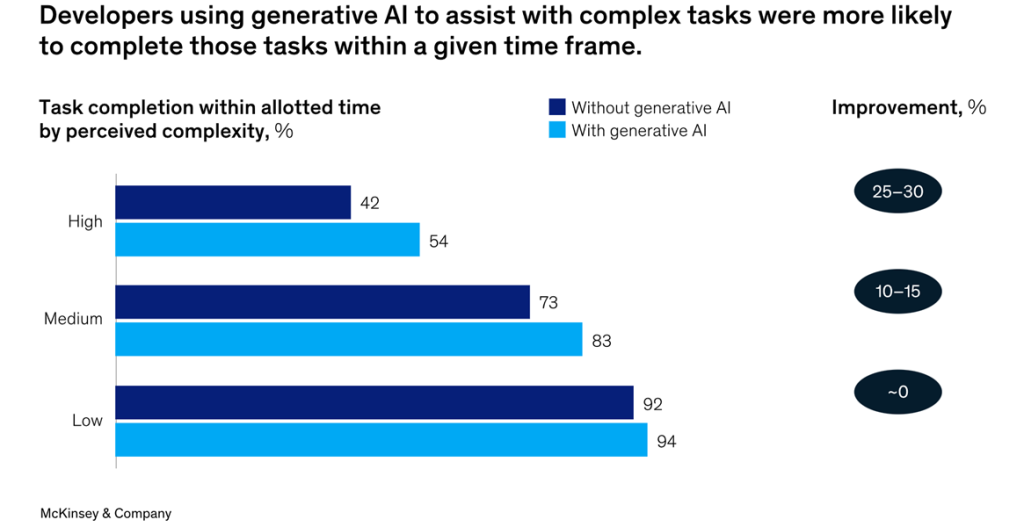
That is the personal-productivity ceiling. A useful floor. Not a strategy.
Tier Two: Team Productivity Is Where Force Multiplication Begins
The leverage shifts the moment you stop optimizing your own keystrokes and start engineering the team’s workflow.
A senior engineer who shaves 30 percent off their own week has improved one engineer’s throughput. A leader who builds an automated flaky-test triage agent, an anomaly detector that catches novel user patterns before they become incidents, or a continuous bug-fixer that opens its own pull requests has changed the system every engineer operates inside. The first is addition. The second is multiplication. The math is not close.
This is also where the vendor-built harness stops carrying you. Off-the-shelf assistants are engineered for the individual contributor’s loop, not the software development lifecycle. They do not know your test infrastructure, your service topology, your incident history, or your customers’ usage signal. To wire AI into those systems, you build the integration yourself; custom MCP servers, enriched internal APIs, evaluation pipelines, approval gates, observability hooks. The model becomes one component inside a system you own and operate.
The work is harder. The leverage compounds across every engineer, every sprint, every release. That is the trade.
Tier Three: Features Are Where the Harness Becomes the Product
The third altitude is the one some leaders fear dabbling in. When AI is embedded in what customers buy, the harness is the product, and two decisions determine whether the embed creates value or noise.
Where does AI fit into the overall system and workflow. Generative AI is never the full solution. It is one component among many; deterministic data lookups, role-based access, audit trails, idempotent action APIs, fallback paths, observability. At Olo, our Menu product is primed for predictive, analytical, and agentic applications across the experience; the Menu Structure Optimizer is one example of a direction that we are heading. Making that work is not a model-selection exercise. It requires building our own MCP server, hardening existing APIs for deterministic lookups and actions, connecting every adjacent system to the AI surface, and designing the chat experience from scratch. Claude Desktop covers most of that out of the box for an individual user. None of it is applicable when you are calling the Claude API from inside a product you own.
This is Build-Your-Own-Harness. The vendor’s scaffold disappears the moment you cross from consumer to producer.
Where does AI truly enhance the experience over a deterministic method. This is the harder discipline, because the honest answer is often “it does not.” Consider using agentic AI for menu product duplication. The pitch is clean: the user asks for a duplicate, the agent performs it. The right answer, though, is likely a first-class deterministic feature; one button, a tested API, a consistent nested-product tree, the same outcome every time. AI would have introduced variance, latency, token burn, and verification cost into an operation that wanted none of them.
Do not add AI just for the sake of AI. When the deterministic path is more reliable, cleaner, and cheaper to verify, it is the right path.
The Market Will Catch Up. The Discipline Will Not Wait.
There is more Build-Your-Own-Harness work to do at the team and feature altitudes than at the personal one, and the market knows it. The major AI vendors are racing to ship snap-in harness modules; agent frameworks, evaluation platforms, MCP catalogs, managed memory, governance layers. The build-buy line is going to shift. The leaders who understand where the AI ends and the harness begins today will absorb those modules cleanly tomorrow, because they will already know what each module needs to do, what it must not be trusted with, and what it cannot replace.
Personal productivity is the floor. Force multiplication is the goal.
One question worth sitting with as you decide where to invest your team’s next quarter:
Will the productivity gain for the median engineer outpace the token cost of getting there?
If the honest answer at the personal tier is “barely,” that is not a reason to retreat from AI. It is a reason to climb to tier two and three.

Leave a Reply